
SFIC Launches Sustainability Furniture Mark Progressive Framework for Healthy Indoor Environments
SFIC LAUNCHES SUSTAINABILITY FURNITURE MARK PROGRESSIVE FRAMEWORK FOR HEALTHY INDOOR ENVIRONMENTS
Progressive Framework equips furniture enterprises to meet growing global demands for healthier indoor environments
SINGAPORE, 29 October 2026 — Singapore Furniture Industries Council (SFIC) today announced the launch of the Sustainability Furniture Mark (SFM) Progressive Framework, supported by Enterprise Singapore (EnterpriseSG). The SFM Progressive Framework provides companies with a structured, three-stage pathway to identify their sustainability gaps and progressively build the capabilities needed to achieve the SFM.
Companies that adopted the SFM have reported positive business outcomes. Scanteak reported an increase of around 10% in its sales closure rate, while Speco saw increased opportunities to pitch its green solutions to industry players and explore how it can help them meet requirements for greener, healthier buildings.
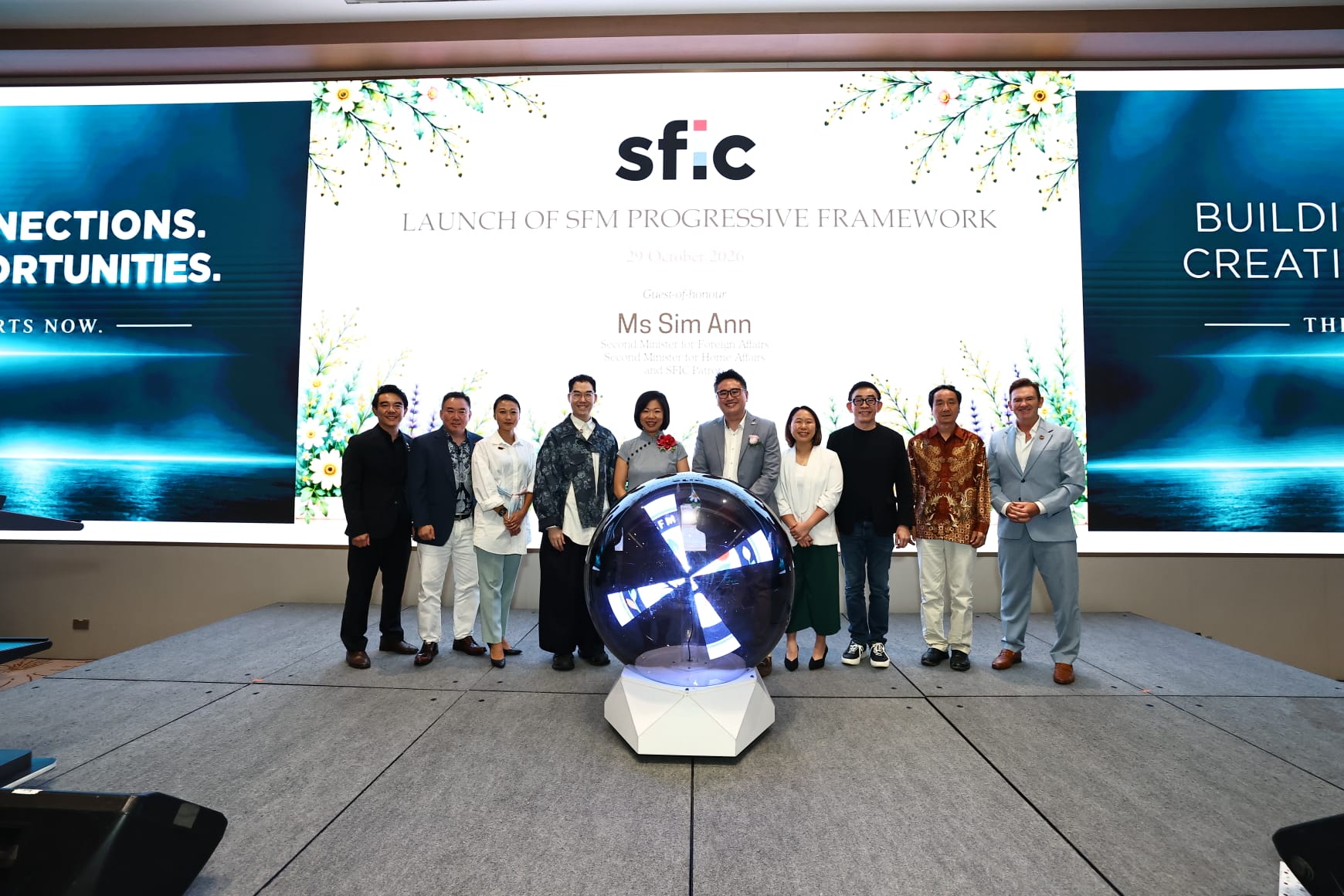
The SFM Progressive Framework was officially launched by Guest of Honour Ms Sim Ann, Second Minister for Foreign Affairs and Second Minister for Home Affairs, and SFIC Patron, during the SFIC Annual Industry Dinner on 29 October 2026. The dinner was attended by over 200 representatives across building, design and retail industries as well as Trade Associations and Chambers (TACs). Ahead of the launch, seven Memorandums of Understanding (MOUs) were signed, and the Sustainability Playbook for the Furniture Industry, developed by EnterpriseSG and SFIC, in partnership with Ernst & Young, was launched at SFIC’s Annual General Meeting on 28 October 2026.
“For our industry, sustainability must be something businesses can put into practice, regardless of where they are in their journey,” Mr Joshua Koh, President, SFIC, said. “The SFM recognition has laid an important foundation by recognising low Total Volatile Organic Compounds[1] (TVOC) emission furniture products. With the SFM Progressive Framework, we are taking the next step – helping companies build the knowledge, technical capabilities and confidence to make better material choices, strengthen their practices and meet changing market expectations. By bringing partners across the value chain together, we hope to make healthier and more sustainable living environments an achievable goal for more businesses, while strengthening the competitiveness of Singapore’s furniture and furnishings industry.”
With national regulatory attention shifting toward formaldehyde[2] and TVOCs, companies and suppliers need to stay ahead of evolving indoor air quality benchmarks. According to Building and Construction Authority (BCA), city dwellers spend up to 90% of the time indoors,[3] making indoor air quality critical for one’s wellbeing. It is also vital for consumers and corporate buyers to pay close attention to regulatory standards as it helps inform them of benchmark levels to maintain healthy levels and avoid health risks that ventilation alone cannot solve.
Building capabilities to turn sustainability into practice
To help companies capture these opportunities, the SFM Progressive Framework provides a staged pathway from understanding sustainability requirements to developing capabilities and strengthening readiness to meet buyer expectations. The three stages cover product and material requirements, responsible business fundamentals, sustainability data and reporting.
Complementing the framework is the Sustainability Playbook for the Furniture Industry, developed by EnterpriseSG and SFIC, in partnership with Ernst & Young. Designed as a self-help guide for companies at different stages of their sustainability journey, the Playbook provides actionable guidance, tools and industry case studies across the furniture value chain.
Together, the framework and Playbook will help companies assess their practices, identify areas for improvement and take steps towards stronger sustainability performance. By building the pool of companies able to supply products that meet SFM requirements, SFIC aims to help the industry respond to buyer demand and compete for business on a stronger footing.
Ms Cindy Ngiam, Director, Retail, EnterpriseSG, said, "Sustainability is fast becoming a mark of quality in furniture and furnishings – consumers are seeking furniture that is safe and responsibly made, while corporate buyers are raising the bar in procurement standards. Companies that move early to meet these expectations will be better positioned to earn customer trust and capture emerging business opportunities. Enterprise Singapore and SFIC are working together to help committed companies build the capabilities to make this shift. Together, the SFM Progressive Framework and the Sustainability Playbook for the Furniture Industry will help more companies turn sustainability into a competitive edge – strengthening their product offerings and driving growth in Singapore and beyond."
Growing demand through partnerships and recognition
SFIC will drive initiatives to build demand for SFM-recognised products. These include partnerships across the value chain, planned agreements with specifiers to recognise SFM-recognised products through the SFM One Leaf and Two Leaf system, and social media campaigns with key opinion leaders (KOLs) to be developed in 2027.
The planned specifier agreements aim to encourage recognition of SFM-recognised products in material selection and project specifications, creating pathways to B2B procurement opportunities. The KOL campaigns will seek to increase consumer awareness and understanding of SFM, helping consumers recognise marked products and consider them in purchasing decisions.
The seven MOUs signed on 28 October 2026 provide a foundation for outreach, knowledge sharing and potential business connections across the furniture, design, renovation, building materials and retail sectors:
- United Nations Global Compact Network Singapore (UNGCNS): Mutual promotion of UNGCNS’ LowCarbonSG initiative, SFM and the SFM Progressive Framework to raise awareness and encourage participation across the organisations’ member networks.
- Society of Interior Designers (Singapore) (SIDS): Programmes to strengthen technical knowledge and sustainable furniture and material selection and specification, alongside opportunities for members to exchange expertise and explore collaborations.
- Bilateral MOU between SFIC and Singapore Retailers Association (SRA), Franchising and Licensing Association (FLA), Singapore Renovation Contractors and Material Suppliers Association (RCMA), and Singapore Building Materials Suppliers’ Association (SBMSA), Singapore Fashion Council (SFC) respectively: Promotion of awareness and adoption of the SFM Progressive Framework, and connections between member companies to explore potential business and procurement opportunities.
“The SFM Progressive Framework provides a platform to deepen our designers’ understanding of sustainable furniture and materials. Through our collaboration with SFIC, SIDS aims to strengthen specification competencies and equip practitioners to make more informed choices, balancing sustainability considerations with professional judgement and design excellence to create healthier indoor environments that support occupant wellbeing,” said Mr Fann Zhi Jie, President, SIDS.
Through the SFM Progressive Framework, SFIC is bringing together
- industry standards,
- market development and
- capability building
to support a more competitive furniture and furnishings industry.
Manufacturers, designers, retailers and suppliers are encouraged to participate, strengthen their practices and explore opportunities across the value chain.
For more information on the Sustainability Playbook for the Furniture Industry, download it here.
Download PDF here: SFIC Press Release - SFIC Sustainability Furniture Mark Press Release.pdf